

Australian Designed
60+ years of expertise

Smart Home Compatible
Wi-Fi and Voice activated assistant option

Energy Efficient DC Motors
Lower running costs

Local Technical Support
Backed by Australian customer service
60+ years of expertise
Wi-Fi and Voice activated assistant option
Lower running costs
Backed by Australian customer service
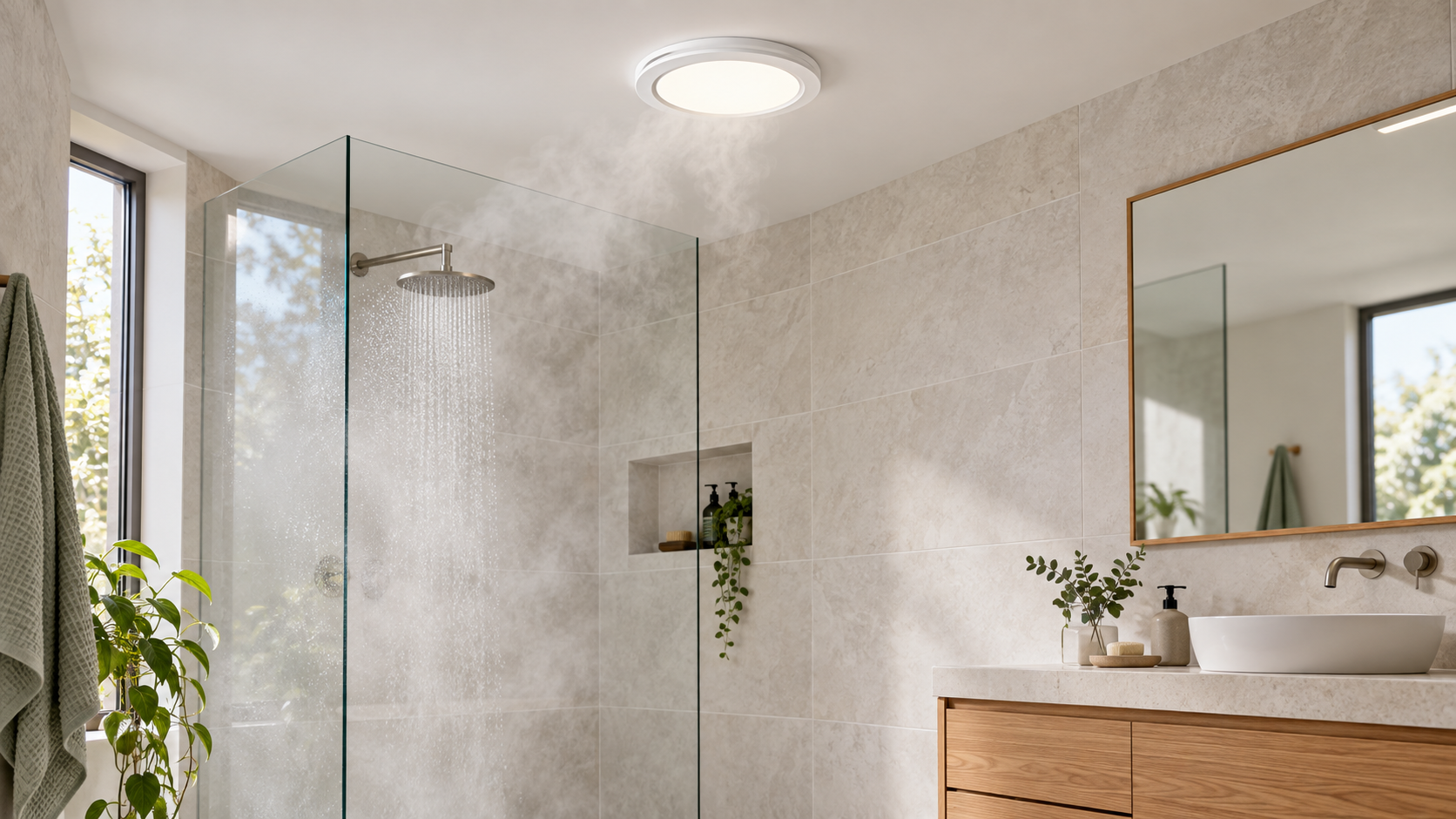
A bathroom exhaust fan helps remove humid air produced by showers and baths. Choosing the right model can support comfort, visibility and moisture management, but the decision involves more than matching a fan to the ceiling cut-out.
Room size, airflow, ducting, make-up air, noise, lighting and installation position all affect performance. This guide explains what Australian homeowners should compare before purchasing a bathroom exhaust fan.
A useful product shortlist should therefore answer two questions: can the fan move enough air for the space, and can the home provide a suitable path for that air from the room to outdoors? Keeping both questions in mind prevents a visually attractive grille from becoming the only selection criterion.
Write down your priorities before shopping. This makes it easier to compare models consistently and gives your electrician useful information when discussing placement, ducting and controls.
Steam raises indoor humidity and can leave condensation on mirrors, walls, ceilings and cabinetry. If humid air is not removed effectively, surfaces can stay damp for longer. Good ventilation forms part of a broader moisture-management approach alongside waterproofing, heating, cleaning and repairing leaks.
An exhaust fan draws air from the room and, in a correctly designed ducted system, discharges it to an appropriate external location. It is important that moist bathroom air is not simply moved into the roof cavity.
Measure the room’s length, width and ceiling height. Floor area is length multiplied by width, while room volume is length multiplied by width multiplied by height. Volume becomes especially relevant when ceilings are higher than standard or the bathroom is unusually shaped.
Four Seasons Living’s Bathroom Heater and Exhaust Fan Finder asks whether the room is a bathroom or laundry and uses its dimensions to recommend suitable products. It is a convenient first filter, but the final selection should also reflect ducting and installation conditions.
A larger grille does not automatically guarantee better performance. Check the published airflow figure for the exact model and confirm that it is appropriate for the room and planned duct arrangement. Long ducts, tight bends and restrictive outlets can reduce real-world airflow.
Compact bathrooms can still generate a large amount of steam, particularly with long, hot showers. Conversely, a powerful fan cannot work effectively if replacement air cannot enter the room. Your electrician or installer can assess the complete air path rather than treating the fan as an isolated component.
As the exhaust fan removes air, new air needs a path into the bathroom. This is often called make-up air. Without it, airflow can be restricted even when the fan itself is correctly sized.
The suitable solution depends on the room and applicable building requirements. It may involve clearance beneath the door or another designed air-transfer path. Avoid modifying doors or building elements without appropriate advice.
Before selecting a model, establish where the extracted air will go. A short, smooth and appropriately sized duct route with minimal bends generally places less resistance on the fan than a long, complicated path. External grilles, backdraft shutters and roof or wall outlets must also be suitable for the installation.
Ask the installer to confirm the required duct diameter and compatible accessories. Reducing duct size or adding unnecessary bends can compromise performance and increase noise.
The fan should be positioned to capture humid air effectively while meeting electrical safety-zone and installation requirements. The best location depends on the shower, bath, door, window, ceiling layout and duct route.
Because bathrooms are wet areas, electrical installation and product placement should be handled by a licensed electrician. Always follow the individual product instructions and relevant requirements.
Noise can be particularly noticeable in an ensuite or bathroom used late at night. Compare available acoustic information where provided, but remember that duct restrictions, loose components and installation quality can influence the sound heard in the room.
Controls also shape everyday performance. A separate switch gives users direct control, while timers or automated controls can help the fan continue operating after a shower. Any control arrangement must be compatible with the product and installed correctly.
An exhaust fan with an integrated LED light can be useful when ceiling space is limited or when general illumination is needed at the same location. Models such as the Exceedance and Extract LED options can be explored in the bathroom ventilation range.
For cold bathrooms, a combined heater, exhaust fan and light may reduce the number of separate ceiling fittings. Heating capacity, extraction performance and lighting should each be assessed on their own merits. Browse bathroom heaters and exhaust fans rather than choosing only by the number of functions in the product name.
If replacing an older unit, measure the existing ceiling cut-out and available cavity space. Do not assume products with similar grille dimensions use the same opening or duct connection. A mismatched cut-out may require ceiling work or a different model.
Also check access above the ceiling, joist positions, insulation, ducting and the external termination. A licensed electrician can identify issues before the new appliance is ordered.
Start with room dimensions, then compare airflow, duct requirements, noise, lighting, heating and control preferences. Confirm ceiling space and the route to an external discharge point. Finally, check installation constraints with a licensed professional.
Use the Bathroom Heater and Exhaust Fan Finder to narrow the options, then explore the full bathroom ventilation range. A well-selected exhaust fan should suit the entire ventilation path and be easy enough to use that it actually operates whenever moisture is produced.
It depends on room area and volume, ceiling height, duct resistance and moisture load. Use a room-size calculator as a starting point and confirm the installation with a professional.
Bathroom moisture should be discharged to an appropriate external location through a correctly designed installation, rather than released into the roof space.
Hard-wired electrical work in a wet area should be completed by a licensed electrician.
It can be a practical space-saving option when the room needs both ventilation and general lighting, provided each function suits the room.
Use the Bathroom Heater and Exhaust Fan Finder to narrow your options, or browse the complete bathroom ventilation range.

September 18, 2026

Don’t miss out. Stay up to date on our exclusive news & offers
Four Seasons Living was created from a desire to bring high-quality, sustainable ceiling fans and home solutions directly to the consumer — without compromising on affordability, design, or performance.
We pride ourselves on fast shipping, exceptional customer service, and delivering thoughtfully designed products that enhance your everyday life.
At Four Seasons Living, our actions, products, and designs reflect our commitment to people and the planet. Sustainability isn’t just a feature — it’s a core value that defines who we are. Our mission is to improve the quality of life for our customers while making a positive impact on the world around us.
Our strategy centres on eco-design, which is integrated throughout every stage of our product and packaging development. This includes the careful selection of sustainable materials, reducing the weight and number of components, and minimising environmental impact wherever possible.
We are also committed to creating products that are durable, repairable, and built to last — all while remaining accessible and affordable.