

Australian Designed
60+ years of expertise

Smart Home Compatible
Wi-Fi and Voice activated assistant option

Energy Efficient DC Motors
Lower running costs

Local Technical Support
Backed by Australian customer service
60+ years of expertise
Wi-Fi and Voice activated assistant option
Lower running costs
Backed by Australian customer service
60+ years of expertise
Wi-Fi and Voice activated assistant option
Lower running costs
Backed by Australian customer service
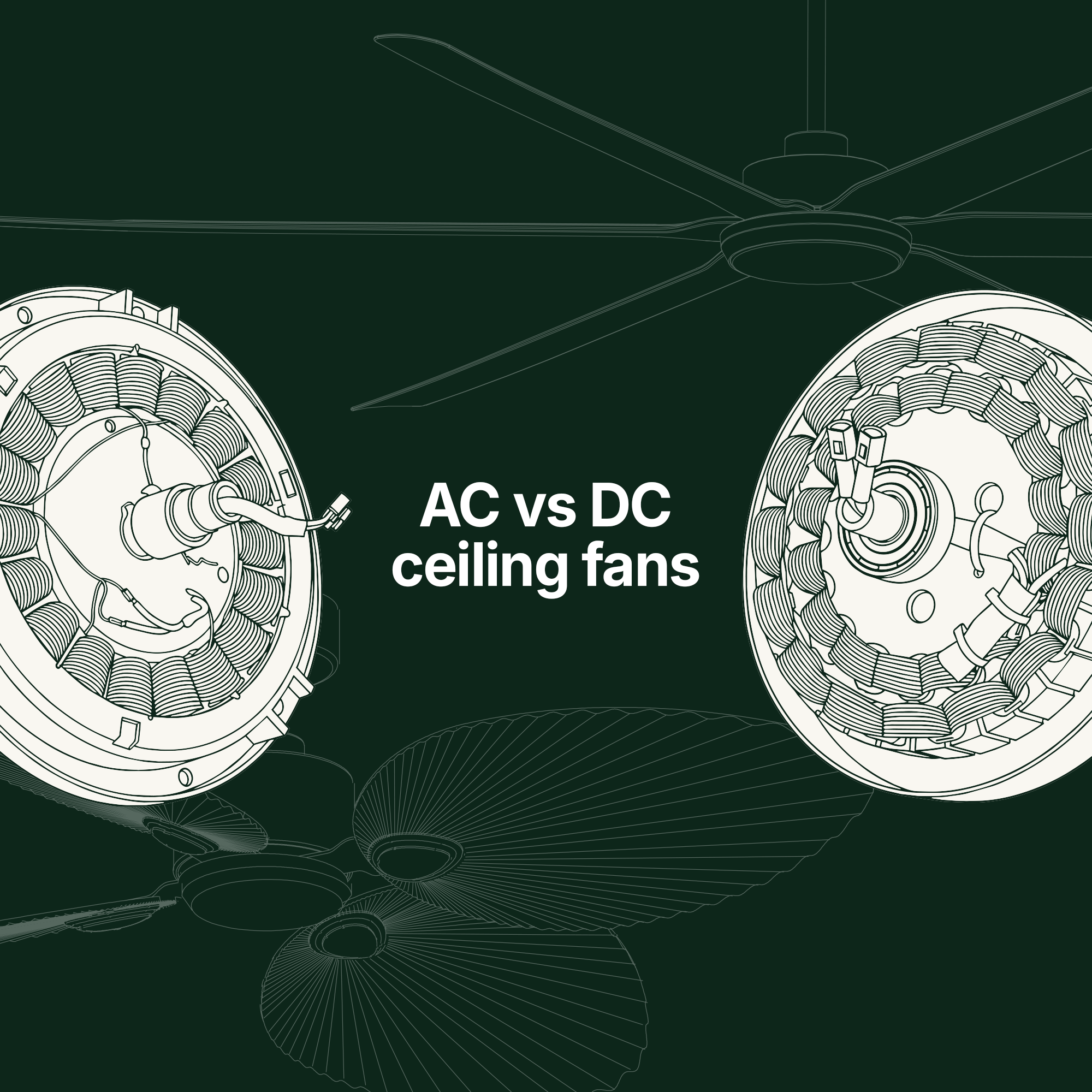
When choosing a new ceiling fan, one of the most important decisions is whether to buy an AC or DC model. Both can improve airflow and help you feel more comfortable, but they differ in energy consumption, noise levels, speed control, features and upfront cost.
So, what is the difference between AC and DC ceiling fans, and which one is better for your home? In this guide, we compare AC vs DC ceiling fans to help you select the right option for your bedroom, living room, outdoor area or open-plan space.
In this context, AC does not mean air conditioning.
An AC ceiling fan uses an alternating current motor, while a DC ceiling fan uses a direct current motor with an internal electronic system that allows it to operate from a standard household electricity supply.
Both types circulate air rather than directly lowering the temperature of a room. The breeze produced by a ceiling fan helps your body feel cooler, which is why fans should generally be switched off when nobody is using the room. Ceiling fans can also work alongside air conditioning to circulate conditioned air more effectively.
| Feature | AC Ceiling Fan | DC Ceiling Fan |
| Energy use | Generally uses more power | Typically more energy efficient |
| Operating noise | Can produce more motor noise | Usually quieter |
| Speed settings | Commonly three speeds | Often six or more settings |
| Controls | Frequently wall controlled | Commonly includes remote control |
| Smart features | Less common | Often available with app or Wi-Fi control |
| Upfront cost | Usually has more budget options | May cost more initially |
| Low-speed control | More limited | Greater control at low speeds |
| Reverse mode | Available on selected models | Often operated from the remote |
| Best suited to | Simple, budget-conscious installations | Bedrooms, modern homes and frequent use |
DC ceiling fans are generally quieter, more efficient and able to provide more speed settings than traditional AC models. AC fans, however, may still suit buyers looking for a straightforward and economical fan with simple controls.
Energy efficiency is one of the main differences between AC and DC ceiling fans.
A DC motor can operate using less electricity while still producing effective airflow. This can make a DC fan particularly attractive in Australian homes where ceiling fans may run for several hours during warm weather.
The NSW Government recommends choosing a DC ceiling fan where possible, noting that DC models can be quieter and substantially more efficient than comparable AC motor fans. The Four Seasons Living range includes energy-efficient models such as the Atlanta 52-inch DC Smart Ceiling Fan, which uses a 26W DC motor while delivering up to 11,099m³/h of air movement.
For households that use their fans regularly, especially overnight or throughout summer, the lower operating power of a DC ceiling fan may provide better long-term value.
A quiet ceiling fan is especially important in bedrooms, nurseries, home offices and study areas.
DC motors tend to operate more quietly than AC motors. Their ability to run smoothly at lower speeds can provide gentle air circulation without as much distracting motor noise.
Australian consumer organisation CHOICE notes that DC ceiling fans tend to be quieter and offer more settings, which can make them particularly suitable for bedrooms.
For example, the Samurai 52-inch DC Smart Ceiling Fan features a quiet 30W DC motor, multiple speed settings and specialised sleep and breeze modes. These options allow the fan to deliver softer airflow while you are resting.
Traditional AC ceiling fans commonly offer three speed settings. This may be enough for basic cooling, but it provides less control when you want a very gentle breeze or a speed between the standard settings.
DC ceiling fans commonly provide six or more settings, allowing you to adjust the airflow more precisely.
Lower speeds can be useful at night, while higher settings can help circulate air through larger rooms. Some DC fans also include a breeze mode that changes the speed automatically to simulate more natural airflow. Many Four Seasons Living DC ceiling fans include six standard speed settings together with specialised sleep and breeze modes.
AC ceiling fans are often operated through a wall controller, although remote-controlled AC models are also available.
Modern DC ceiling fans frequently include a remote control as standard. Depending on the model, the remote may control:
Smart DC ceiling fans may also connect to a mobile application or compatible voice assistant.
The Spartan 52-inch DC Smart Ceiling Fan can be controlled using its included remote, a smartphone or compatible voice assistants such as Alexa and Google Home.
Smart controls can be convenient in bedrooms, high-ceiling areas and open-plan spaces where reaching a wall controller may not always be practical.
Both AC and DC ceiling fans can be purchased with integrated lighting. However, modern DC models often include more advanced LED options.
A ceiling fan with an LED light can be a practical choice when the fan is replacing an existing central light fitting. It allows one ceiling fixture to provide both airflow and general room lighting.
The Shinzo 52-inch DC Smart Ceiling Fan with LED Light includes a dimmable 16W LED light with adjustable warm-to-cool colour temperature settings. It is also suitable for indoor and covered outdoor applications.
When comparing ceiling fans with lights, check whether the fan and light can be controlled separately and whether the brightness and colour temperature can be adjusted.
AC ceiling fans generally have more options at the lower end of the market. This can make them suitable for rental properties, spare rooms or projects where initial purchase cost is the main consideration.
DC ceiling fans can cost more upfront because of their motor technology and electronic controls. However, they may offer better value over time through:
The best choice should not be based on motor type alone. Airflow, room size, fan diameter, blade design, warranty and intended location should also be considered.
A reversible ceiling fan can be useful throughout the year.
During summer, the blades should create a downward breeze that helps people in the room feel cooler. During winter, reverse mode can gently circulate warm air that has collected near the ceiling.
Many DC fans allow the direction to be changed directly from the remote. With some older AC models, the reverse switch may be located on the fan body, making it less convenient to access.
Government energy guidance recommends using a low-speed clockwise setting during winter to circulate warm air without creating an uncomfortable draught.
A quiet DC ceiling fan with several low-speed settings is usually the better choice for a bedroom. Look for sleep mode, timer functions and remote control.
The Atlanta, Samurai and Shinzo DC ranges are suitable options for bedrooms and everyday living spaces.
For medium and large living areas, consider a 52-inch fan with strong airflow and several speed options.
For particularly large rooms, the Everest 80-inch DC Smart Ceiling Fan provides an expansive 2050mm blade span, a 35W DC motor and maximum air movement of up to 14,475m³/h.
For a patio, veranda or covered alfresco area, select a fan specifically approved for covered outdoor installation.
The Marley 52-inch DC Smart Ceiling Fan is designed for indoor and covered outdoor applications. Its five-blade design delivers airflow of up to 11,354m³/h from a 35W DC motor.
Always check the product’s location rating. A covered outdoor fan is not necessarily suitable for direct exposure to rain, water or unrestricted weather conditions.
A more compact model may provide better proportions and airflow control in a small bedroom, study or home office.
The Combat 48-inch DC Ceiling Fan offers a smaller 1220mm diameter than the standard 52-inch models, making it an option worth considering for more compact spaces.
A fan installed too close to a high ceiling may not deliver air effectively to the occupied area below. For high-ceiling installations, a compatible 900mm ceiling fan downrod can lower the fan to a more effective operating height.
The correct downrod length and mounting arrangement should be confirmed with your electrician before installation.
An AC fan may be suitable when you:
A DC fan may be the better choice when you:
For most modern Australian homes, DC ceiling fans provide the strongest combination of efficiency, quiet operation, flexible speed control and convenient features.
The ideal ceiling fan depends on the size of your room, ceiling height, preferred controls, lighting needs and installation location.
Four Seasons Living offers a selection of energy-efficient DC ceiling fans for bedrooms, living rooms, covered outdoor areas and expansive open-plan spaces. Options include compact 48-inch fans, versatile 52-inch smart fans and an impressive 80-inch model for larger rooms.
Explore the complete range of DC ceiling fans at Four Seasons Living and find a model that suits your space, style and comfort needs.
Always have a hard-wired ceiling fan installed by a licensed electrician in accordance with the product instructions and applicable electrical requirements.

July 10, 2026

Don’t miss out. Stay up to date on our exclusive news & offers
Four Seasons Living was created from a desire to bring high-quality, sustainable ceiling fans and home solutions directly to the consumer — without compromising on affordability, design, or performance.
We pride ourselves on fast shipping, exceptional customer service, and delivering thoughtfully designed products that enhance your everyday life.
At Four Seasons Living, our actions, products, and designs reflect our commitment to people and the planet. Sustainability isn’t just a feature — it’s a core value that defines who we are. Our mission is to improve the quality of life for our customers while making a positive impact on the world around us.
Our strategy centres on eco-design, which is integrated throughout every stage of our product and packaging development. This includes the careful selection of sustainable materials, reducing the weight and number of components, and minimising environmental impact wherever possible.
We are also committed to creating products that are durable, repairable, and built to last — all while remaining accessible and affordable.