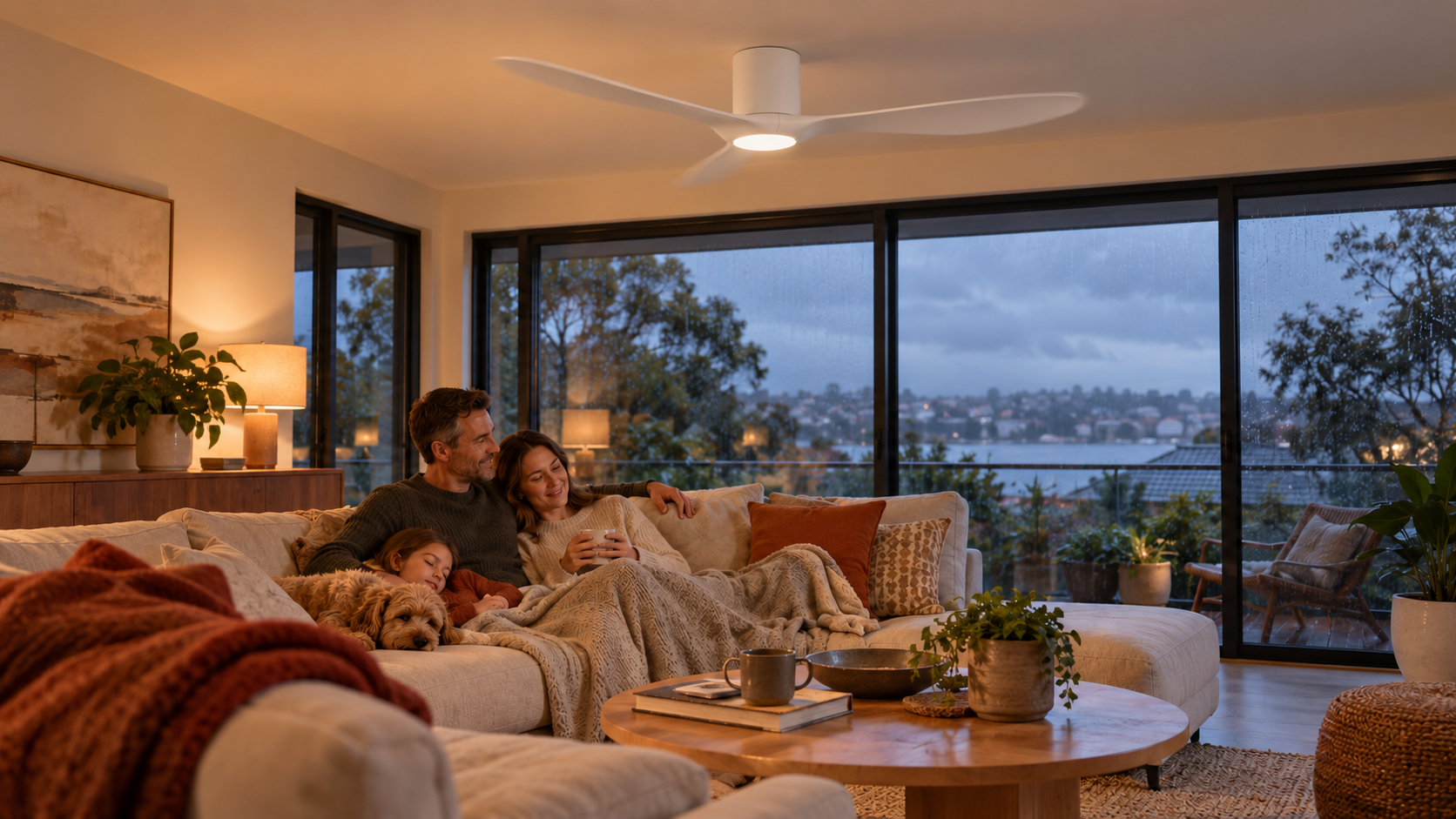
Ceiling fans are often associated with hot Australian summers, but a reversible fan can also be useful in winter. Warm air naturally rises and may collect near the ceiling, particularly in rooms with high ceilings. Winter or reverse mode helps circulate that warmer air through the occupied part of the room.
The aim is not to create the strong downward breeze used for summer cooling. A fan in winter mode should usually operate gently, helping even out temperature without making occupants feel cold. Used appropriately, it can complement a heater and make the room feel more consistently comfortable.
How winter mode works
In summer mode, a ceiling fan generally creates a downward airflow that moves across the skin and produces a cooling sensation. In winter mode, the blade direction reverses. At low speed, the fan draws air upward and encourages circulation around the room, helping move warm air away from the ceiling.
The correct direction must be confirmed from the fan’s instructions because blade design and control conventions can vary. Many modern DC models allow direction to be changed from the remote rather than through a switch on the fan body.
More even room comfort
Heating can leave noticeable temperature layers: warmer air near the ceiling and cooler air where people sit or walk. Gentle fan circulation can reduce this stratification, making the room feel more even from one area to another.
This can be especially helpful in open-plan living areas, stair voids and rooms with raked or high ceilings. Results depend on fan position, ceiling height, heating type, room shape and insulation, so adjust the speed and heating settings gradually.
Supporting your heating system
A winter-mode fan does not generate heat. Instead, it redistributes heat already produced by a heater, fireplace or sunlight. By making better use of warm air in the room, it may help occupants achieve comfort without concentrating all warmth near the ceiling.
Any energy benefit depends on how the household responds. If improved circulation allows a sensible thermostat adjustment or shorter heating runtime, consumption may fall. Running the fan while leaving heating behaviour unchanged still adds the fan’s own electricity use, even if that amount is relatively modest for an efficient model.
Low speed is usually the key
Fast airflow can feel cool on the skin, which works against the purpose of winter operation. Begin at the lowest speed and assess comfort after the room has had time to circulate. The ideal setting should not create a noticeable draught in the occupied zone.
Fans with several speed choices provide more control. Smart or remote-operated models can make it easier to fine-tune the setting from floor level and change direction without reaching the fan.
Benefits in rooms with high ceilings
High ceilings provide more space for warm air to rise above the occupied zone. A correctly sized and positioned fan may help bring some of that warmth back into circulation. A suitable downrod can also affect how well the fan interacts with the room’s air volume.
Mounting height, clearance and downrod suitability must follow the product instructions and be assessed by a licensed electrician. Do not change mounting components simply to improve winter circulation without confirming compatibility.
Using a fan with different heating types
With reverse-cycle air conditioning, a fan can help distribute conditioned air beyond the immediate outlet. With a fireplace or other localised heat source, gentle circulation may reduce hot and cool pockets, but the fan must be positioned safely and must not interfere with flues or combustion requirements.
For portable or fixed heaters, maintain all manufacturer clearances and safety instructions. A ceiling fan is a circulation aid, not a substitute for safe heating, insulation or appropriate ventilation.
Potential energy and comfort advantages
Winter fan use may support more efficient heating habits by helping warmth reach the occupied zone. It can also reduce the urge to select an unnecessarily high thermostat setting simply because the lower part of the room feels cool.
Calculate the combined cost rather than assuming savings. The electricity-saving guide explains how household habits, sensible heating temperatures and efficient appliances work together. Comfort improvements may be valuable even when energy savings are small or vary from day to day.
Choosing a reversible ceiling fan
If year-round use matters, confirm that the fan is fully reversible and check how direction is controlled. Also compare low-speed performance, airflow, noise, motor input, room suitability and available blade spans. Quiet, stable low-speed operation is particularly important in bedrooms.
Four Seasons Living states that current Atlanta, Samurai, Marley, Combat and Everest DC models can switch between summer and winter operation by remote. Product specifications can change, so verify the exact listing and manual before ordering. Browse the ceiling fan range or start with the Ceiling Fan Finder.
Common winter-mode mistakes
The most common mistake is running the fan too fast, creating an unwanted breeze. Other issues include using the summer direction, expecting the fan to heat an unoccupied room, or leaving it operating when circulation is no longer useful.
Another mistake is ignoring the building itself. Draughts, uninsulated ceilings, poorly fitted curtains and air leaks can undermine comfort. Combine fan use with appropriate insulation, window coverings and maintenance for a more complete winter strategy.
A practical winter setup
Check the manual for reverse mode, set the fan to its lowest speed and turn on the normal heating system. Allow time for the room temperature to settle, then assess comfort at seated and standing height. If you feel a cooling breeze, reduce the fan speed or confirm the direction.
Make small thermostat adjustments only after comfort improves, and monitor the result. Different weather, occupancy and sunlight may require different settings. Smart schedules can help, but they should be updated when routines or seasons change.
Comfort throughout the year
A reversible ceiling fan earns its place beyond summer by supporting air circulation in cooler months. The main benefits are more even warmth, better use of heat already in the room, convenient low-speed circulation and the possibility of more measured heating choices.
For more seasonal ideas, read the year-round home comfort guide and AC vs DC ceiling fan guide. Select a suitable reversible model through the Ceiling Fan Finder, have it installed by a licensed electrician and use winter mode gently. A small change in airflow can make a tall or unevenly heated room noticeably more comfortable.
Frequently asked questions
Which way should a ceiling fan turn in winter?
Use the manufacturer’s stated winter or reverse direction. It is commonly described as clockwise when viewed from below, but the manual is the safest reference.
What speed should I use in winter?
Start at the lowest speed. The goal is gentle circulation without a noticeable cooling draught.
Does a ceiling fan heat a room?
No. It redistributes existing warm air and must be used with an appropriate heat source when heating is needed.
Should I run a ceiling fan all winter?
Run it when circulation improves comfort. Switch it off when the room is empty or when it provides no practical benefit.
Explore the range
Browse the ceiling fan range or use the Ceiling Fan Finder to find options suited to your room, installation location and lighting preferences.